Most travelers who come to me with a polar expedition in mind have already decided they want to go to one of the poles. What they have not decided is which one. And that decision matters more than they often realize, because the Arctic and Antarctica are not interchangeable versions of the same experience. They are genuinely different worlds, with different landscapes, different wildlife, different emotional textures, and different logistical realities.
I have worked with travelers who were certain they wanted Antarctica and came away feeling the Arctic was the right first expedition. I have worked with others who assumed the Arctic would do and discovered, once we talked through the specifics, that Antarctica was the only answer. The right choice is almost always clear once you understand what distinguishes them.
This is the conversation I have with every polar-bound traveler before anything is planned or booked. Here is the substance of it.
I plan polar expeditions through my Fora and Virtuoso affiliations, which give me access to vetted operators across both polar regions. For a broader overview of how expedition cruising works before getting into the Arctic versus Antarctica question, my piece on Antarctica expedition cruises explained covers the fundamentals.
The Fundamental Difference
Antarctica is a continent. It is a landmass the size of the United States and Mexico combined, covered by ice up to two miles thick, surrounded by the Southern Ocean. It has no permanent human population. No government. No infrastructure beyond a handful of research stations. It exists entirely outside the systems of civilization, and that fact is felt viscerally when you are there.
The Arctic is an ocean. The North Pole sits on sea ice floating above the Arctic Ocean, surrounded by the northernmost reaches of inhabited land: Norway, Russia, Canada, Greenland, Alaska. Indigenous communities have lived in the Arctic for thousands of years. The landscape is dramatic and remote, but it is not untouched in the way Antarctica is. The human presence in the Arctic, historical and current, is part of what makes it interesting.
That distinction, continent versus ocean, wilderness versus inhabited edge, shapes almost everything else about how each destination feels.
Wildlife: Two Completely Different Rosters
This is often the deciding factor for travelers who care deeply about wildlife, and it should be considered carefully because the two poles do not share any significant species.
Antarctica
Antarctica is defined by penguins, seals, and whales. Millions of penguins in colonies that exist nowhere else on earth. Leopard seals, Weddell seals, crabeater seals hauled out on ice floes. Humpback whales feeding in krill-rich waters close enough to the ship that you can hear them breathe. Albatrosses following the vessel across the Drake Passage.
There are no land predators in Antarctica. No bears, no wolves, no foxes. The wildlife has no fear of humans and no evolutionary reason to have developed any. Walking through a penguin colony, with birds moving around and past you as though you are simply another feature of the landscape, is one of the most remarkable wildlife experiences available anywhere on earth. The absence of fear changes everything about the encounter.
The Arctic
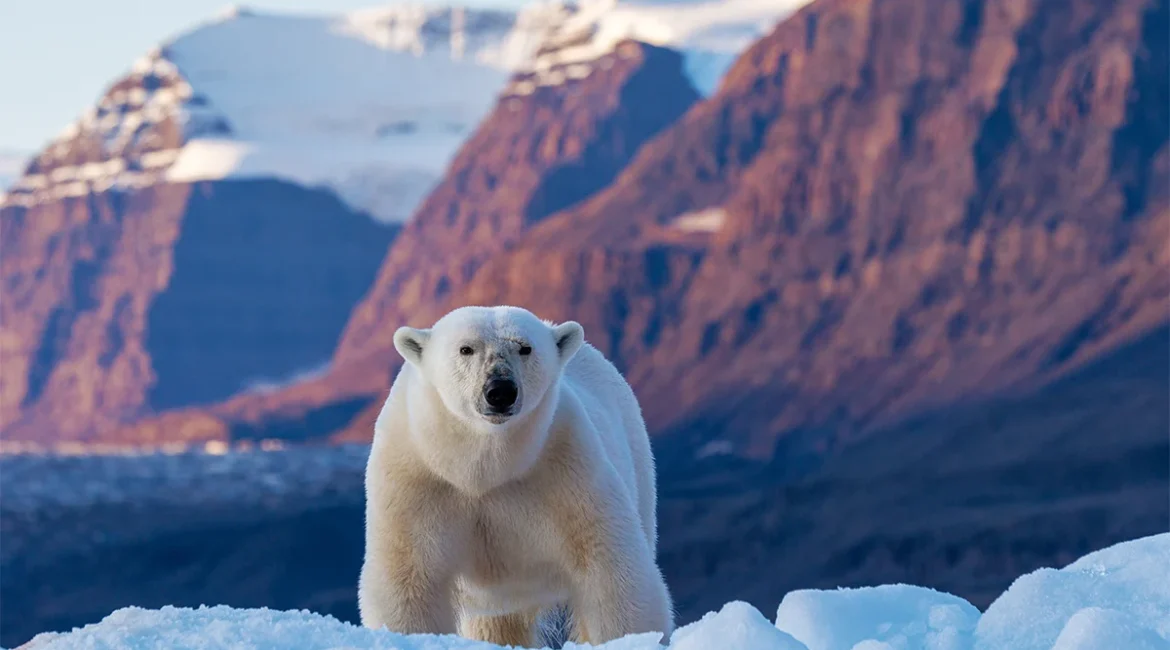
The Arctic’s signature animal is the polar bear, and for many travelers that fact alone settles the question. A polar bear on sea ice, viewed from a Zodiac at close range, is an encounter that Antarctica simply cannot offer. The Arctic also has walrus in large herds on rocky beaches, Arctic fox, reindeer, musk ox in Greenland, narwhal in certain regions and seasons, and beluga whales. Svalbard in particular offers some of the most reliable polar bear sightings available anywhere.
The Arctic also has significant seabird colonies, including little auks, puffins, and thick-billed murres, that nest on dramatic cliff faces in numbers that are genuinely staggering. For bird-focused travelers, the Arctic seabird colonies are world-class.
The clearest way I have found to frame this: if penguins are the image in your head when you think about a polar expedition, you want Antarctica. If polar bears are, you want the Arctic. Most travelers have one or the other as their primary image, and that instinct is usually right.
Landscape: Ice Continent vs Ice Ocean
Antarctica
The Antarctic landscape is on a scale that the human eye struggles to process. Icebergs the size of office buildings, calved from glaciers that dwarf anything in the northern hemisphere. The ice shelf stretching to the horizon. Mountains rising from the ice without foothills or transition, simply appearing. The silence is so complete in certain places that it produces a physical response in travelers who have never experienced it.
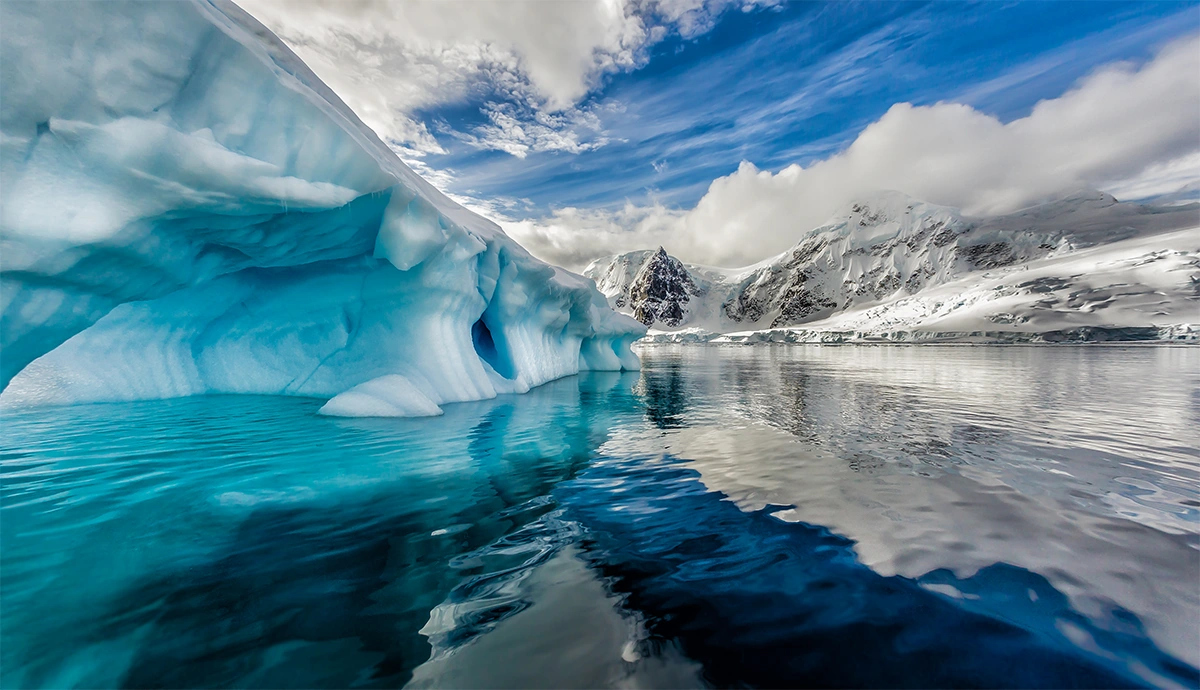
The Antarctic Peninsula, where most expedition cruises operate, combines this ice-dominated landscape with volcanic rock, sheltered bays, and the particular quality of polar light that photographers travel specifically to capture. It is one of the most visually dramatic environments on the planet.
The Arctic
The Arctic landscape is more varied than Antarctica’s and, in some ways, more intimate. Svalbard has fjords, tundra, dramatic cliff formations, and a flora that surprises travelers who expect nothing but ice: Arctic poppies, saxifrage, and other low-growing plants that colonize every patch of exposed ground in summer. Greenland’s ice sheet is comparable in scale to Antarctica’s, but the western coast offers a combination of ice and fjord scenery that is distinctive and spectacular in its own right.
The human element in the Arctic landscape is also part of its character. Abandoned whaling stations, Inuit settlements, the remnants of polar exploration history scattered across the archipelago. These layers of human story give the Arctic a different kind of depth from Antarctica’s pure wilderness.
Logistics and Accessibility
Getting There
Antarctica is harder to reach, and that difficulty is part of its power. Most expeditions depart from Ushuaia, Argentina, involving international flights to Buenos Aires and a connecting flight south. The Drake Passage crossing adds two days each way. The journey to Antarctica is genuinely significant, and most travelers feel that significance before they arrive.
The Arctic is considerably more accessible. Svalbard, the most popular Arctic expedition base, is served by direct flights from Oslo, which connects to most major international hubs. Greenland expeditions typically route through Reykjavik or Copenhagen. The logistics are materially simpler, which makes the Arctic a more practical choice for travelers with limited time or who prefer a shorter journey.
Season
Antarctica’s season runs November through March, the austral summer. The Arctic season runs roughly May through September, the boreal summer. The seasons do not overlap, which means if a traveler has a specific travel window in mind, the calendar sometimes makes the decision for them.
Travelers who can only go in summer, meaning June through August by northern hemisphere standards, are in the Arctic season and outside the Antarctic season. Travelers planning for November or January or February are in Antarctica’s window. This is often the first filter I apply when a traveler comes to me undecided.
Cost
Both polar regions represent a significant investment. Antarctica expeditions tend to run slightly higher than comparable Arctic expeditions, reflecting the greater distance, longer voyage time, and the logistics involved in operating in the Southern Ocean. That said, the range within each destination is wide. A no-frills adventure expedition to Svalbard and a luxury small-ship voyage to Antarctica are both polar experiences but occupy entirely different price categories.
I work with operators across both regions and at multiple price points through my Fora and Virtuoso partnerships. The right conversation is not about which pole is more affordable in the abstract but about what the right vessel and experience looks like for a specific traveler, in either region, and what that actually costs.
The Question I Always Ask
When a traveler comes to me genuinely undecided between the Arctic and Antarctica, I ask them one question: what do you want to feel when you get there?
If the answer involves a sense of being at the absolute edge of the world, of standing somewhere that has existed almost entirely without human presence, of a scale and silence that makes ordinary life feel briefly irrelevant, that is Antarctica.
If the answer involves wildlife encounters at close range with animals that carry genuine danger, of landscape that layers wilderness with human history, of an expedition that feels remote but not utterly beyond the reach of civilization, that is the Arctic.
Neither answer is wrong. They are just different things, and understanding which one you are after is the work that makes the planning meaningful.
The travelers I have worked with who have done both almost always describe them as complementary rather than comparable. Antarctica first, typically, because its singularity is hard to follow with anything else. The Arctic after, because it offers things Antarctica does not and rewards a traveler who already understands what expedition cruising is.
Which One Should You Do First?
If someone comes to me having never done a polar expedition and asks which one to start with, my honest answer is usually Antarctica, with some caveats.
Antarctica’s singularity is difficult to overstate. It is the most remote, the most otherworldly, the most untouched destination accessible to civilian travelers anywhere on earth. For many travelers, it becomes the defining journey of their lives, the one everything else is measured against. Doing it first means experiencing it without comparison, which I think is the right way to encounter something that extraordinary.
The caveat is the Drake Passage. Travelers who are genuinely uncertain about their tolerance for rough seas should consider starting with the Arctic, where the sailing conditions are generally calmer and the fly-in option for Svalbard eliminates ocean crossing entirely. There is no benefit to a miserable Drake Passage crossing on a first polar expedition.
For travelers with no seasickness concerns and no calendar constraints, Antarctica first is my standard recommendation. But the right answer is always the one that fits the specific traveler, not the general principle.
Contact me today to talk through which polar expedition is the right fit for you. Whether the answer is the Arctic, Antarctica, or both, the planning starts with understanding exactly what you are looking for.