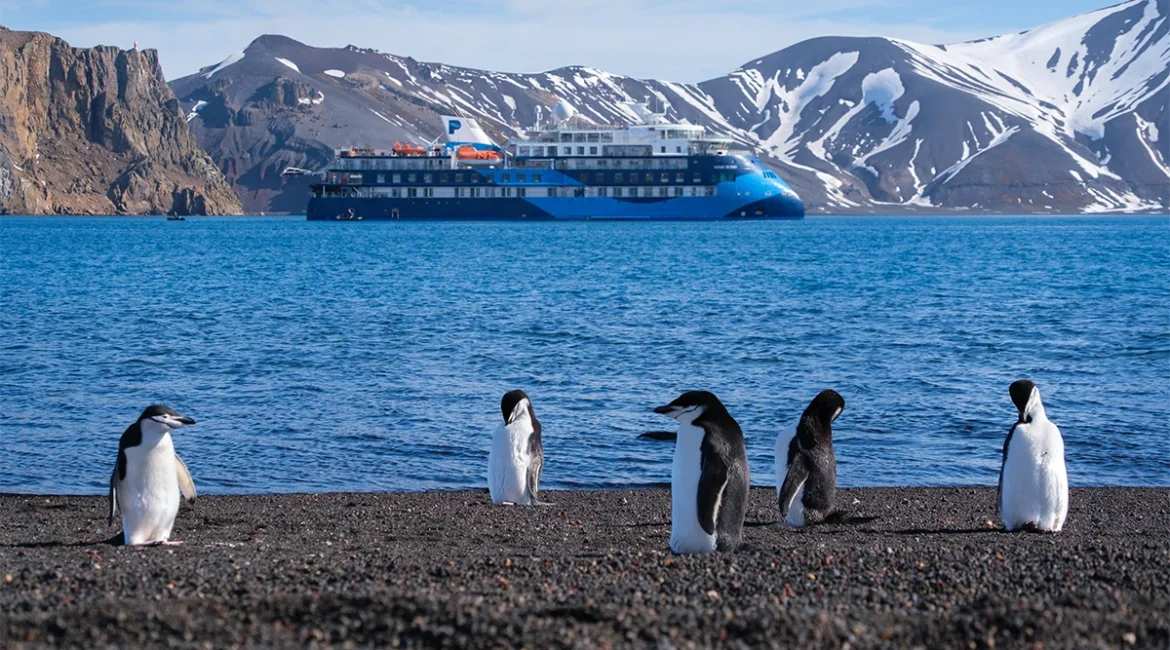
When travelers start researching Antarctic expedition cruises, they tend to focus on the obvious variables: the operator’s reputation, the itinerary, the cabin category, the price. Ship size is often treated as a secondary consideration, something to look at after the main decisions are made. That is a mistake, and it is one I see regularly among first-time polar travelers.
In Antarctica, ship size is not a secondary consideration. It is one of the most consequential decisions in the entire planning process, and it shapes the experience in ways that nothing else does. The reason comes down to a single regulation that most travelers do not know about until someone explains it to them.
The Rule That Changes Everything
The International Association of Antarctica Tour Operators, known as IAATO, governs visitor activity on the continent. Among its regulations is a rule that limits the number of people who can be ashore at any landing site at one time to 100 passengers. One hundred people, maximum, regardless of how many are on the ship.
The implications of that rule are significant. A ship carrying 200 passengers can only put half its guests ashore at any given time. While one group lands, the other waits on the ship. Then the groups rotate. This means that on a 200-passenger vessel, every traveler spends a meaningful portion of every expedition day watching Antarctica from the water rather than standing on it.
On a ship carrying 100 passengers or fewer, everyone goes ashore together. There is no rotation, no waiting, no portion of the day spent on the ship while the continent is right there.
I have spoken with travelers who returned from Antarctic expeditions on larger ships feeling that the experience was not quite what they had imagined. When we talked through the details, the rotation system was almost always part of it. They had not fully understood, before departure, that they would spend significant time watching from the deck while others were ashore. That is not a failure of the expedition. It is a consequence of ship size, and it is entirely avoidable with the right planning.
Small Ships: What the Experience Actually Looks Like
On a small expedition ship, typically carrying between 50 and 100 passengers, the daily rhythm is fundamentally different from a larger vessel.
The morning briefing happens. The Zodiacs are prepared. When conditions are right and the landing site is ready, everyone boards the Zodiacs and goes ashore together. The landing site belongs to the group for the duration of the visit. The expedition team fans out across the area. Travelers move at their own pace, spend as long as they want in the penguin colony, and return to the ship when the landing window closes.
There is no clock running on a rotation. No awareness that another group is waiting their turn on the ship. The experience is complete.
Small ships also carry proportionally larger expedition teams relative to passenger numbers, which means more naturalists, more guides, more opportunities for substantive conversation with experts during landings and onboard lectures. The educational quality of a small-ship expedition is almost always higher than a larger vessel, and that dimension of the Antarctic experience is one of the things travelers consistently describe as unexpectedly significant.
Large Ships: What You Are Trading Off
Ships carrying more than 100 passengers are not permitted to land more than 100 guests at a time, but they are not excluded from Antarctica entirely. Larger vessels, some carrying 200 or more passengers, operate in Antarctic waters and offer an experience that is genuine and often spectacular. The Drake Passage crossing, the wildlife sightings from the deck, the onboard lectures, the sheer drama of the Southern Ocean: none of that is diminished by ship size.
What is diminished is the on-ice time. On a 200-passenger ship, every traveler gets roughly half the landing time they would get on a sub-100-passenger vessel, and they spend the other half waiting. For some travelers, particularly those who are more interested in the voyage itself than the landings, this trade-off is acceptable. For travelers who came specifically to stand on Antarctica, to walk through a penguin colony, to step onto the continent and feel what that actually feels like, it is a significant compromise.
Larger ships do sometimes offer amenities that smaller ships do not: more spacious public areas, a wider range of cabin categories, certain onboard facilities. But in my experience working with polar travelers through my Fora and Virtuoso affiliations, the travelers who prioritized those amenities and ended up on larger ships rarely felt it was the right trade. The ones who prioritized landing time and chose accordingly almost never had regrets.
The Capacity Spectrum
Within the sub-100-passenger category, there is still meaningful variation worth understanding.
Ultra-Small: Under 50 Passengers
Some expedition vessels carry fewer than 50 passengers, and these offer the most intimate Antarctic experience available. With a small group, landing sites feel genuinely uncrowded even by Antarctic standards. The expedition team has more individual attention to give. The ship can access shallower anchorages and smaller landing sites that larger vessels cannot reach. Some of the most remote and rarely visited areas of the continent are accessible only to vessels of this size.
The trade-off is typically cabin comfort and onboard space. Smaller ships are more utilitarian, and the Drake Passage crossing on a 48-passenger vessel is a different physical experience from crossing on a 100-passenger ship. Neither is necessarily worse, but the motion is more pronounced on a smaller hull.
Small Expedition: 50 to 100 Passengers
This is the category I recommend most often for travelers who want the full on-ice experience without the austerity of the smallest vessels. Ships in this range, offered by operators including Silversea, Ponant, Nat Geo x Lindblad, Quark, HX, and Atlas in various configurations, deliver the complete landing experience with generally higher standards of accommodation than the ultra-small category.
The variation within this range is significant. A 60-passenger luxury vessel from one operator and a 96-passenger adventure-focused ship from another are both sub-100 but feel entirely different in terms of comfort, service, and onboard character. This is where working with someone who knows the specific vessels matters, because the category label does not tell the full story.
Over 100 Passengers
These ships operate legally in Antarctic waters and offer a genuine expedition experience. But they cannot land everyone at once, and that fact should be understood clearly before booking. If a traveler comes to me specifically asking about larger ships, I explain the rotation system in full and let them make an informed decision. Some travelers are genuinely fine with it. Most, once they understand the alternative, choose differently.
The 100-passenger rule is not obscure information, but it is not prominently disclosed in most operator marketing either. Part of what I do for polar-bound travelers is make sure this is one of the first things we discuss, not one of the last.
Ship Size and Itinerary Access
Beyond the landing rotation question, ship size affects where a vessel can go in Antarctica. The Antarctic Peninsula has a range of landing sites, from the most visited and well-known to remote locations that see only a handful of expeditions per season. Access to the latter is largely determined by vessel size and draft.
Smaller ships can navigate shallower channels, anchor closer to landing sites, and access bays that larger vessels must pass by. For travelers interested in the more remote and less visited parts of the peninsula, the ship size question and the itinerary access question are connected. A smaller ship is not just a different experience of the same places. It is access to different places entirely.
What I Look for When Recommending a Vessel
When a traveler comes to me planning an Antarctic expedition, ship size is one of the first variables I establish. Before we look at operators, before we discuss cabin categories or price, I want to understand whether this traveler is prioritizing on-ice experience above all else or whether they have other priorities that might shift the calculus.
For most travelers, the answer is clear once the 100-passenger rule is explained: they want to be ashore, not waiting on the ship. From there, I work within the sub-100 category and match vessel to traveler based on what the specific ship delivers in terms of expedition quality, crew expertise, educational programming, and comfort.
The operators I work with through my Fora and Virtuoso affiliations give me access to preferred pricing, added amenities, and the kind of detailed vessel knowledge that goes beyond what appears in a brochure. If you are starting to plan an Antarctic expedition and want to understand which ships are worth considering and why, contact me today and we can work through it together.