
The first time I helped a traveler plan a private yacht charter in Greece, I was struck by how much they did not know they did not know. They had been to Greece before: Santorini, Mykonos, the usual circuit. They had loved it. But they felt like they had seen the postcard version of a country that was hiding something much better just out of reach.
They were right. And a private charter is how you find it.
Greece has over 6,000 islands. Fewer than 230 are inhabited. The ones that make most travelers’ itineraries are spectacular, but they are also crowded, overpriced in peak season, and designed for the masses. A private crewed yacht puts the rest of the archipelago within reach: the hidden coves, the villages that do not have souvenir shops, the anchorages where you wake up to nothing but water and silence.
If you are considering a charter for the first time, this guide covers everything you need to know before you commit: from how the process works to what questions to ask, what decisions actually matter, and how to avoid the mistakes I see first-timers make.
What a Private Crewed Yacht Charter Actually Is
A crewed charter means the vessel comes with a captain and at least a cook and hostess. The crew handles the sailing, the provisioning, the anchoring, and the day-to-day logistics. Your job is to show up, make decisions about where you want to go, and enjoy it. A bareboat charter, by contrast, means you sail it yourself, which requires certifications and experience I will address separately.
For most of the travelers I work with, a crewed charter is the right choice. It is not just more comfortable. It is a fundamentally different experience. A good captain is also a local guide. They know where to anchor ahead of the crowds, which beach is only accessible from the water, which taverna on a small island has been run by the same family for three generations. They also remain flexible with itinerary within reason to maximum your enjoyment. That knowledge is not something you can replicate with a map.
The crew makes the charter. I have seen beautiful boats with mediocre crews produce forgettable trips. I have seen modest boats with exceptional crews produce the kind of weeks people talk about for the rest of their lives. When I vet operators for my travelers, the crew profile is the first thing I look at.
Crewed vs. Bareboat: Which Is Right for You?
Crewed Charter
This is the right choice if you want to relax, if you do not have sailing experience, or if the experience itself matters to you beyond just the destinations. The crew handles everything operational. You focus on the journey.
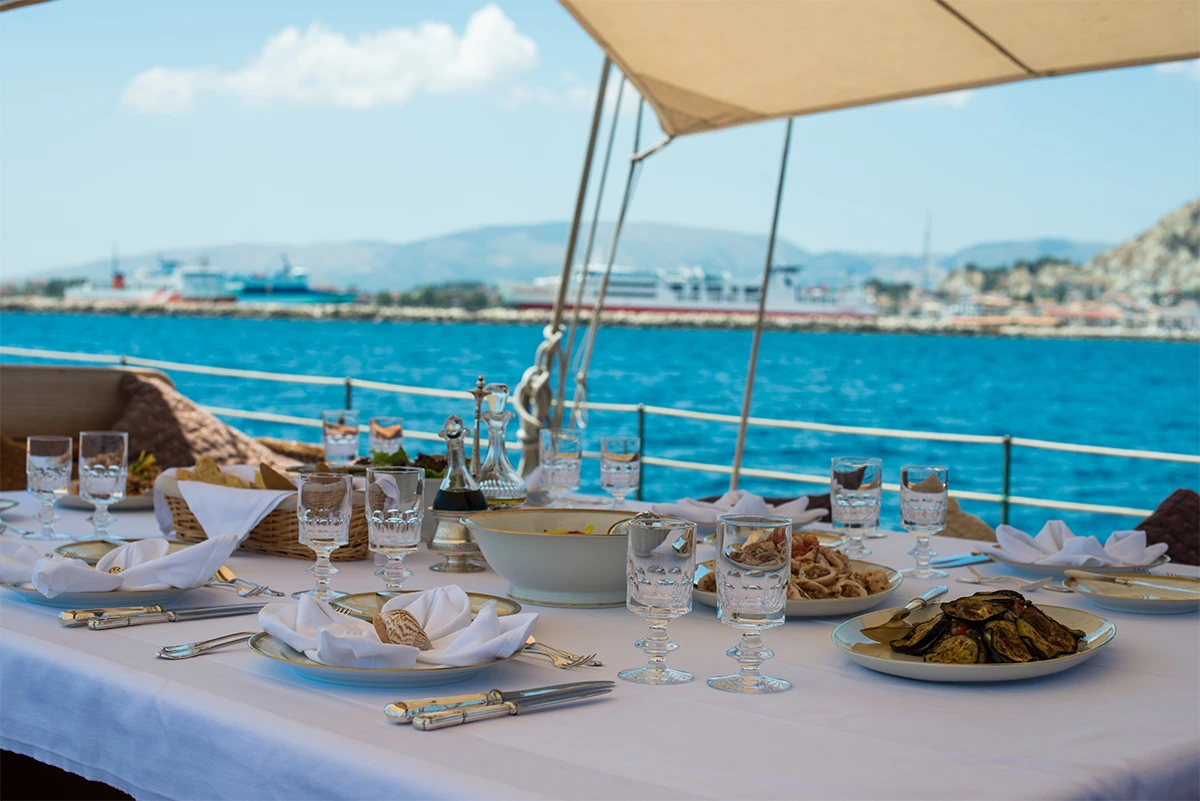
Crewed charters range from gulet-style wooden vessels with a laid-back, Mediterranean feel to sleek modern sailing yachts and motor yachts with high-end interiors. Most crewed charters include at minimum a captain and a hostess who doubles as cook.
Bareboat Charter
A bareboat charter is the vessel without crew. You are the skipper. This option is for experienced sailors who hold recognized certifications, typically RYA Day Skipper or equivalent, and are comfortable navigating Greek waters, which can be demanding in certain island groups, particularly the Aegean.
I occasionally work with sailors who want bareboat charters, but the majority of my travelers choose crewed. If you are asking the question “crewed vs. bareboat,” the answer is almost always crewed. Experienced sailors rarely need to ask.
Skippered Charter
A middle option: you rent a bareboat but hire a captain separately. This works well for travelers who want a more casual setup than a full crewed charter while still having professional navigation. It is less common but worth knowing exists.
Choosing Your Route: The Greek Island Groups
Greece’s sailing geography divides into distinct island groups, each with its own character. The right one depends on what kind of experience you are after.
The Cyclades
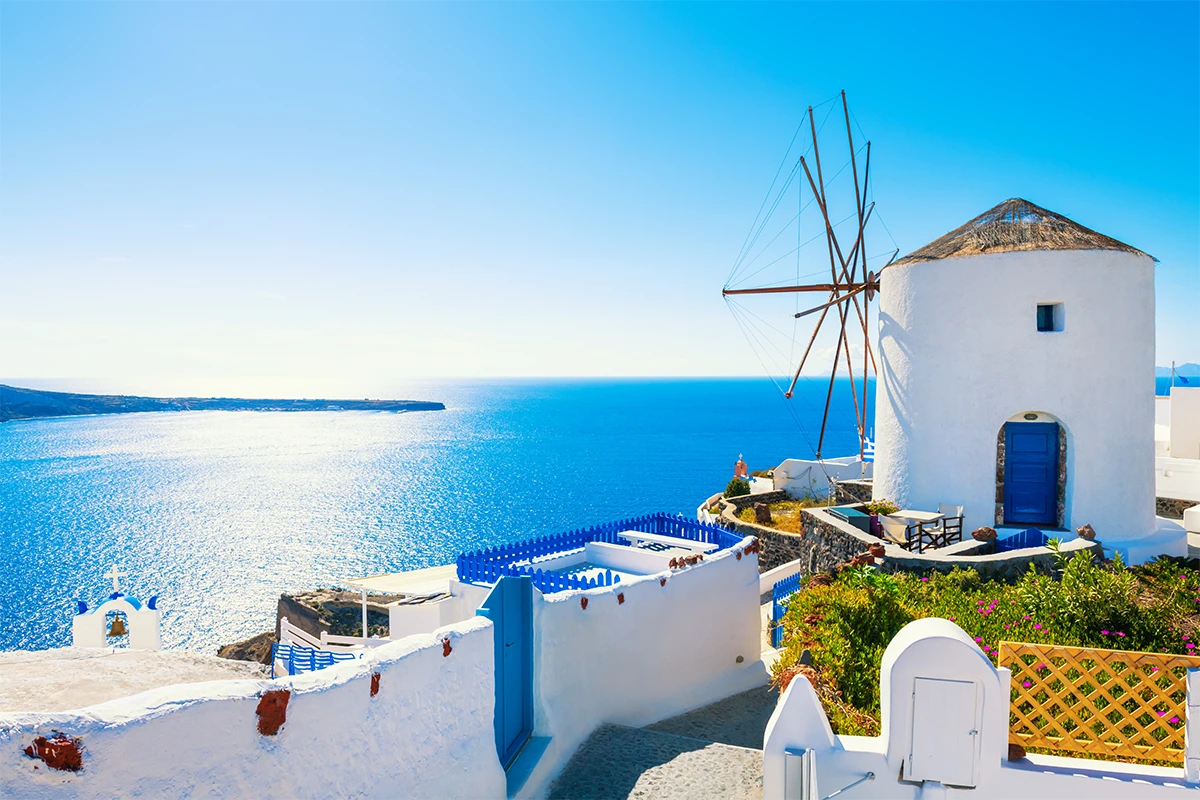
The most iconic Greek sailing territory. Whitewashed villages, volcanic landscapes, crystalline water. Mykonos and Santorini anchor the group, but the islands in between, Folegandros, Milos, Sifnos, Koufonisia, are where the real magic happens. The Cyclades can have strong summer winds (the meltemi), which creates excellent sailing conditions but can make certain crossings uncomfortable for those prone to seasickness. I always flag this with first-time charter guests.
The Ionian Islands
The west coast group: Corfu, Lefkada, Kefalonia, Ithaca, Zakynthos. Calmer seas than the Cyclades, lush green landscapes, Venetian architecture in the main towns. The Ionian is often recommended for first-timers because the conditions are more forgiving and the island-hopping distances are shorter. It also tends to be slightly less crowded than the Cyclades in peak summer.
The Dodecanese
The southeastern group, anchored by Rhodes and Kos but stretching toward Turkey to include gems like Patmos, Symi, and Tilos. The Dodecanese offers a strong mix of history, culture, and natural beauty. The sailing distances are longer, which suits travelers who want fewer stops and more time at sea. I often recommend this group for late-season charters in September and October, when the light is extraordinary and the crowds have thinned.
The Sporades
A quieter, greener group in the northern Aegean: Skiathos, Skopelos, Alonnisos. Heavily forested islands, turquoise water, a more relaxed pace. Alonnisos sits at the center of Greece’s first marine national park. The Sporades are often overlooked by first-timers fixated on the Cyclades, which is precisely why I love recommending them to the right traveler.
My most common recommendation for first-time charter guests: the Cyclades, with a base in Athens or Paros and a route that intentionally avoids Mykonos and Santorini until the last day or two. The islands in between are extraordinary and almost entirely uncrowded by comparison.
What to Expect: A Week on the Water
The rhythm of a crewed charter is genuinely unlike any other form of travel. You wake up anchored in a bay. The boat may be the only vessel there, or there may be a handful of others. The hostess has coffee ready. You decide over breakfast, with input from the captain on wind and conditions, where you want to go that day. The captain plots the route. You set sail mid-morning.
Depending on the distance, you might sail two to four hours, stopping to swim off the boat before reaching the next anchorage. Lunch is typically served at anchor. The afternoons are yours: snorkeling, kayaking, a nap, a book. Late afternoon, you motor into a harbor village or find a secluded bay for the night. Dinner is either onboard or ashore at a local restaurant the captain recommends.
What surprises most of my travelers is how quickly they decompress. There is no agenda beyond the one you choose each morning. The pace is entirely yours.
Understanding Charter Costs
This is where first-timers often have the widest gap between expectation and reality. A private crewed charter in Greece is a significant investment. Here is how the cost structure works.
The Charter Fee
This is the base rental cost of the vessel for the week. For a motor yacht accommodating 4 to 6 guests, expect to start around $50,000 per week for a more modest crewed vessel in shoulder season, and $70,000 or more for a premium yacht in high season. APA: Advance Provisioning Allowance
Almost all crewed charters include an APA on top of the base rate, typically 30 to 35% of the charter fee. This covers fuel, provisioning (food and drink onboard), mooring fees, and port taxes. At the end of the charter, you receive an accounting of how the APA was spent and either pay the difference or receive a refund. First-timers are often surprised by this, so I always explain it clearly upfront.
Crew Gratuity
Standard practice is to tip the crew 10 to 20% of the charter fee at the end of a successful week. For a charter that genuinely delivers, exceptional food, outstanding navigation, a crew that anticipates your needs, I encourage my travelers to tip generously. The crew works hard and lives aboard for the duration.
Flights and Pre/Post Accommodation
Getting to Greece and spending a night or two in Athens before and after the charter are separate costs. I almost always recommend arriving a day early in Athens or wherever the charter originates. Flights can be delayed, and you do not want to be rushing to the marina the morning of departure.
The math that most surprises first-timers: when you divide the total charter cost by the number of guests, a high-quality crewed charter in Greece often compares favorably to a week at a top resort on a per-person basis, especially once you factor in what is included. The intimacy, the exclusivity, and the access are simply not replicable at any price at a hotel.
Choosing the Right Vessel
Yacht selection is where I spend a significant amount of time with my travelers. The right vessel depends on several factors.
Group Size
Most charter yachts sleep 6 to 12 guests in 3 to 6 cabins. Be honest about how much privacy you need. A family of four on a 6-cabin yacht has a very different experience than six adults who are comfortable sharing close quarters. I always ask about sleeping arrangements before I begin narrowing vessel options.
Sailing vs. Motor Yacht
Sailing yachts are the classic Greek charter experience. They are quieter, more fuel-efficient, and tend to attract guests who want to feel connected to the journey. Motor yachts cover distances faster and offer more deck space and stability, but they are noisier underway and more expensive to fuel. Gulets, the traditional wooden motor-sailing vessels common in Greek and Turkish waters, offer a third option: more space, a convivial atmosphere, and a distinctly Mediterranean character.
Age and Condition of the Vessel
A newer yacht is not always better. Some of my favorite vessels are well-maintained older boats with character and excellent crews. What matters is the maintenance record and the crew’s professionalism. I vet this before making any recommendations.
Onboard Amenities
Think about what matters to you. Air conditioning? A watermaker? A jet ski or paddleboard? WiFi? These vary significantly by vessel. I match amenities to what my travelers actually care about, rather than defaulting to the most expensive option.
When to Go
The Greek sailing season runs from late April through October. Here is how the seasons break down.
- May and early June: Shoulder season. Fewer crowds, lower prices, green landscapes from spring rain. The sea is cooler but can still be swimmable. This is one of my favorite times to charter. You have the islands largely to yourselves.
- July and August: Peak season. The meltemi wind blows hard in the Cyclades, which creates excellent sailing but can make certain crossings rough. Marinas and popular anchorages are crowded. Prices are at their highest. I recommend peak season only for travelers who specifically want the energy of the islands in full swing, or who have no flexibility in dates.
- September and early October: My top recommendation for most travelers. The sea is warm, the light is extraordinary, the crowds have thinned, and the meltemi has eased. Late-season sailing in Greece is, in my experience, as good as it gets anywhere in the world.
How the Booking Process Works
Start Early
The best vessels for the most desirable weeks, late June and September in particular, book 6 to 12 months in advance. If you are targeting a specific region or vessel type, I recommend beginning the conversation at least eight months before your intended departure.
The Charter Agreement
Once a vessel is selected, you sign a charter agreement and pay a deposit, typically 50% of the charter fee. The balance is due 4 to 8 weeks before departure, along with the APA. I review the charter agreement with my travelers before anything is signed.
The Preference Sheet
Before departure, the charter company sends a preference sheet for you to complete. This is where you specify dietary restrictions, food preferences, preferred activities, wines you enjoy, anything you want more or less of. A good crew reads this carefully and uses it to personalize the entire week. Take it seriously.
Working with an Advisor
I manage the vessel search, the negotiation, the contract review, and the coordination with the charter company. There is no additional fee for my planning services on charter bookings.
What First-Timers Get Wrong
- Overpacking the itinerary: The instinct is to see as much as possible. The reality is that the best charter weeks are the ones where you slow down, stay an extra night in an anchorage you love, and let the journey breathe. I always counsel my travelers to plan fewer stops than they think they want.
- Underestimating the APA: Budget for about 30% on top of the charter fee for running expenses. Travelers who do not plan for this are sometimes caught off guard by the final accounting.
- Choosing the boat over the crew: The crew is the charter. A beautiful boat with the wrong captain produces a mediocre week. I vet crews before I recommend any vessel.
- Skipping Athens: Flying directly to the charter base to save time is a false economy. Athens is magnificent, and spending two nights there before or after the charter makes the entire trip feel more complete. I always build it in.
- Going in August without knowing what August means: The crowds, the prices, and the meltemi are real. Travelers who go in expecting September and get August are often disappointed. I manage expectations clearly before anyone commits to a peak-season date.
Planning a Greek Yacht Charter with Tray Tables Up
A private charter in Greece is one of the most personal travel experiences I plan, and one of the most rewarding to get right. The vessel, the route, the crew, the season: every element shapes whether the week simply meets expectations or becomes something my travelers talk about for years.
Through my Fora and Virtuoso affiliations, I have access to vetted operators, preferred charter partnerships, and the kind of on-the-ground knowledge that comes from working with these itineraries across many seasons. If Greece is calling, I would love to help you figure out where to go, what to sail on, and how to make the most of every day on the water.
Contact me today to get your Greek Yacht Charter planned. The best weeks and boats go fast.